
Many of you have heard on our sidelines or through social media channels that the age group structure is changing in youth soccer. This is true. The change will begin in April/May during our tryout process as we form teams for the 2026-27 season, and then formally launch in the fall season of 2026. This is the first communication regarding this topic, it will not be the last. We will continue to communicate throughout the spring so that everyone is aware and understands the change and how it will affect our club, our teams, and your player. Below are explanations and answers to frequently asked questions as well as an opinion letter from Executive Director, Carson Porter.
Big Picture Notes and Changes:
This change is a directive and requirement that comes from the governing bodies of Youth Soccer: U.S. Youth Soccer (USYSA) and US Club Soccer. These organizations oversee the 3 leagues that Hammerheads Soccer players and teams participate in:
o U.S. Youth Soccer (USYSA) oversees North Carolina Youth Soccer (NCYSA) and South Carolina Youth Soccer (SCYSA) and our Youth Academies
o US Club Soccer oversees ECNL National and Regional programs
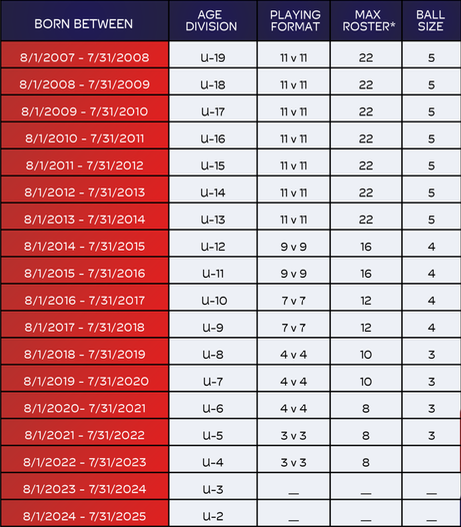
The change moves away from the current “birth year” age group model (January – December) and returns to a “Grade/Seasonal” age group model (August – July).
Hammerheads Soccer Club and its affiliates must adhere to this change to continue to compete in U.S. Youth Soccer, US Club Soccer and ECNL leagues.
The Specifics:
Starting in the 2026-27 season, age groups will be built with August 1st as the earliest date of the new 12 month calendar, and July 31st of the following year being the last date.
Transition from Birth-Year to School year: The existing birth-year model (January-December), implemented in 2017, will revert to the school-year model (August - July) for better consistency in player development, and an overall healthier long-term experience. Supportive points of this are:
o Having teammates in the same grade fosters friendships.
o Being more connected to grade years helps when players transition to high school soccer (8th grade / 9th grade)
o College soccer recruiting is more consistent when the majority of players are in the same graduating class.
Impact on Players: We will primarily follow the school/grade year structure. We do anticipate that approximately 15% of our club members will fall within the August birth year window, making them eligible for both the current and new systems. Special exceptions may be considered on a case-by-case basis, depending on talent and pool considerations.
Application Across All Competitions: This change will affect all Hammerheads Soccer Club teams and participants.
o The system-wide shift will bring change. A Players’ age will be categorized into the new 12-month window, and this will affect team formation.
o We are committed to ensuring a smooth transition for the 2026-27 season while prioritizing the growth and development of every player.
Next Steps:
If you have any questions or concerns regarding these changes, please don't hesitate to reach out to your respective director. See below for additional commentary from Executive Director, Carson Porter.
AGE GROUP CHANGE: 2026/27
Families -
As we move closer to spring, we want to continue to communicate about the age group change that will take effect in the upcoming fall of 2026 (2026-27 season).
The Age Group Change: connecting more players to their school year
U.S. Soccer is mandating a shift from current Jan. 1st - December 31st calendar-year age groups, to August 1st – July 31st grade-based age groups. This change is intended to better align club soccer age groups with school grade levels. While any transition brings adjustment, we support this change and believe it benefits players’ long-term development.
Reasons, Explanations and Examples:
1. Addressing a 'gap' in the high school years
Under the current model, U15 age group teams often include a mix of 8th and 9th-grade players. In the current scenario, 9th grade teammates have a competitive and time consuming HS season; while their 8th grade teammates do not have the programming that they need. This results in extended periods where 8th grade players have no games or appropriate programming, while their 9th grade teammates are fully committed to their high school seasons.
This situation occurs again 3 years later when half of a Hammerheads team graduates from from high school and the other half are left without club soccer programming in their senior year.
Aligning age groups by grade, when possible, elimintates programming gaps and creates more consistent schedules that lead to better development opportunities for all players.
2. College Recruiting Clarity:
As players get older and have college ambitions - college coaches recruit strictly by grade-level—not chronological age. When rosters include players from multiple graduating classes, confusion can arise and opportunities can be missed. As an example, a college coach might not need a defender in their 2027 recruiting class but need one in their 2028 recruiting class - and not realize that a 2028 graduating prospect is playing with a team full of 2027 graduates. This confusion is eliminated when teams are made up largely of players in the same grade helping college coaches evaluate and recruit more accurately.
3. Younger players and peer connections
Research consistently shows a strong connection between friendships and initial participation for our youngest players. While not always the case, this new model better supports early age participation by grouping players who are more likely to be classmates in school - thus improving the chances of familliarity and friendship for our youngest players.
How are the Hammerheads Approaching this change?:
We recognize that this change will disrupt a system that has become familiar to our club and has worked for us. Even so, we believe this transition serves the best long-term interests of our players based on the reasons laid out above. This is also something that all clubs in our state and country are going to go through. It will require work, communicaition, and understanding in the short term, but in the long term this change makes sense.
Team Formation for the 2026-27 Season:
We will be releasing tryout information for the 2026-27 season in the coming weeks and month. These tryouts will happen during the months of April and May.
To begin this process cleanly and consistently without confusion, all players will begin the 2026-27 tryout and team-building process in the new age group structure that the player fits into (August 1 - July 31). This allows us to see these player pools together, and establish a clear starting point.
With that said, we know and are very aware that there will be unique circumstances that need to be reviewed, discussed and addressed. This is already going on internally. Our staff is analyzing player pools, age groups, individual player situations, etc. Please know that we are on top of this and are doing a lot of work in preparation for the change. There will be a time for individual conversations, but we don't need to have those yet.
The 26-27 tryout registration will include a detailed informational form that will ask you to provide any/all information regarding your player's circumstances. Being that you are receiving this message and already a member of the club, we will likely already know what your circumstances are - but we will address all of them and make sure you are heard and listened to.
After the tryout process, we will build teams based on the explanations above. We will communicate with groups and families who have unique circumstances, and then 'turn the page' and begin looking ahead to the fall.
Thank you for supporting your player, and know that we are on top of this.
Carson Porter,